"Building a Deck in Winter: What Actually Stops Work, and What Doesn't"
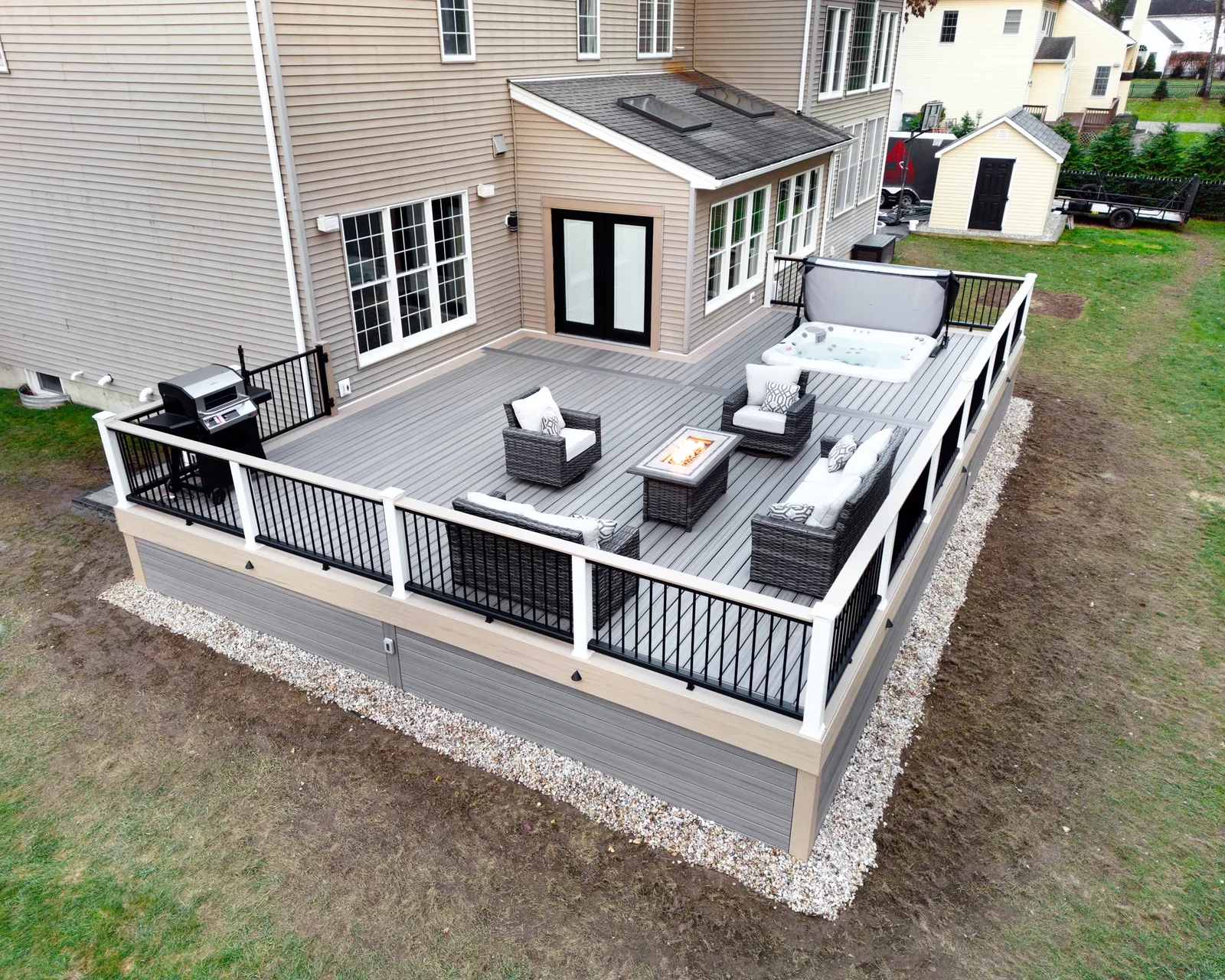
The call comes in October. The homeowner has been thinking about it all summer, finally decided, and then apologizes for the timing.
"I guess we're looking at spring."
Not necessarily.
We work through the winter months with equipment that gets into the ground when the ground does not want to cooperate. Frozen soil is a condition to plan around, not a stop sign.
What winter actually changes
Being honest about this matters more than being enthusiastic about it, so here is the real list.
Foundations get easier to argue for, not harder. A helical pile is turned into the ground with a machine until it hits its torque spec, well below frost depth. Frost in the top of the soil column is not the obstacle for that system — it is exactly the condition the system was designed around. Poured concrete footings are the part of the job winter genuinely complicates: cold slows the cure, and protecting fresh concrete from freezing takes time, cover, and heat. When the calendar says February, the foundation conversation usually answers itself.
Board spacing changes. This is the part almost nobody outside the trade knows. Composite decking installed at twenty degrees is contracted. The same board in July will be longer. An installer who spaces winter boards the way they space summer boards is building tight joints that will fight each other in the first heat wave. Install temperature is a real input, and the gap schedule has to be set against it.
Site access matters more. Snow cover, soft mud during a thaw, and a truck that has to reach the back of a property are scheduling problems, not engineering ones. They are worth walking before anyone signs.
Municipal pace varies. Permits and inspections continue through the winter, but scheduling can be less predictable in some towns than in others. That is a timeline question we sort out during design, not a reason to wait.
What winter does not change
The design work. The engineering. The permit package. The material order. The framing. The railing. The lighting plan.
None of that cares what month it is.
The part that actually costs you
Here is the practical argument for not waiting.
Every deck builder in the Hudson Valley is booked solid from April through July. That is when everybody calls, because that is when people are standing in their backyard wishing they had a deck. A project that starts in the winter is designed, engineered, permitted, and built on a calendar that is not fighting every other homeowner in three counties for the same weeks.
The homeowner who calls in October and waits for spring does not get a spring build. They get a spring quote, and a summer build, and a deck they finally use in August — for one month before the season turns.
The one who starts in the winter is sitting on it in May.
Where this fits
None of this is an argument for rushing a build into bad conditions. There are days no honest crew should be pouring, framing, or setting boards, and we do not pretend otherwise.
It is an argument against the assumption that a cold month is a lost month. The foundation system, the install temperature, and the site access are all things to plan for. They are not reasons to lose a season.
Doing it right costs less than doing it over. Doing it *sooner* usually costs less than doing it late.
Frequently asked
Can you really install deck footings in frozen ground?
Helical piles, yes — they are driven to a torque specification well below the frost line, and frozen surface soil is a condition the equipment handles. Poured concrete footings are the harder winter proposition, because cold weather slows curing and fresh concrete has to be protected from freezing. Which foundation makes sense is decided by the site and the season together.
Will a deck built in winter have gaps in the summer?
Not when the spacing is set for the install temperature. Composite boards are contracted in the cold and expand as they warm, so a winter install requires a different gap schedule than a July install. The failure people have seen — tight joints that buckle, or gaps that open wide — comes from ignoring install temperature, not from building in the cold.
Does building in the off-season mean a rushed job?
The opposite, usually. Winter and early spring are when a crew is not stacked three projects deep, which means more attention on your build and a schedule with room in it. The peak-season backlog is what produces rushed work.
What if the weather turns bad mid-project?
Some days are genuinely not workable, and we do not force them. That is built into a winter timeline rather than discovered halfway through. The parts of the job that continue regardless — design, engineering, permits, material staging, fabrication — keep the project moving on the days the weather does not cooperate.
When should I call if I want to use the deck next summer?
Earlier than most people think. Design, engineering, and permitting take real time before anyone breaks ground. A fall or winter call is what puts a finished deck under you at the start of the season instead of the end of it.