Why Composite Deck Boards Move — and What Prevents Gaps, Buckling, and Crooked Seams
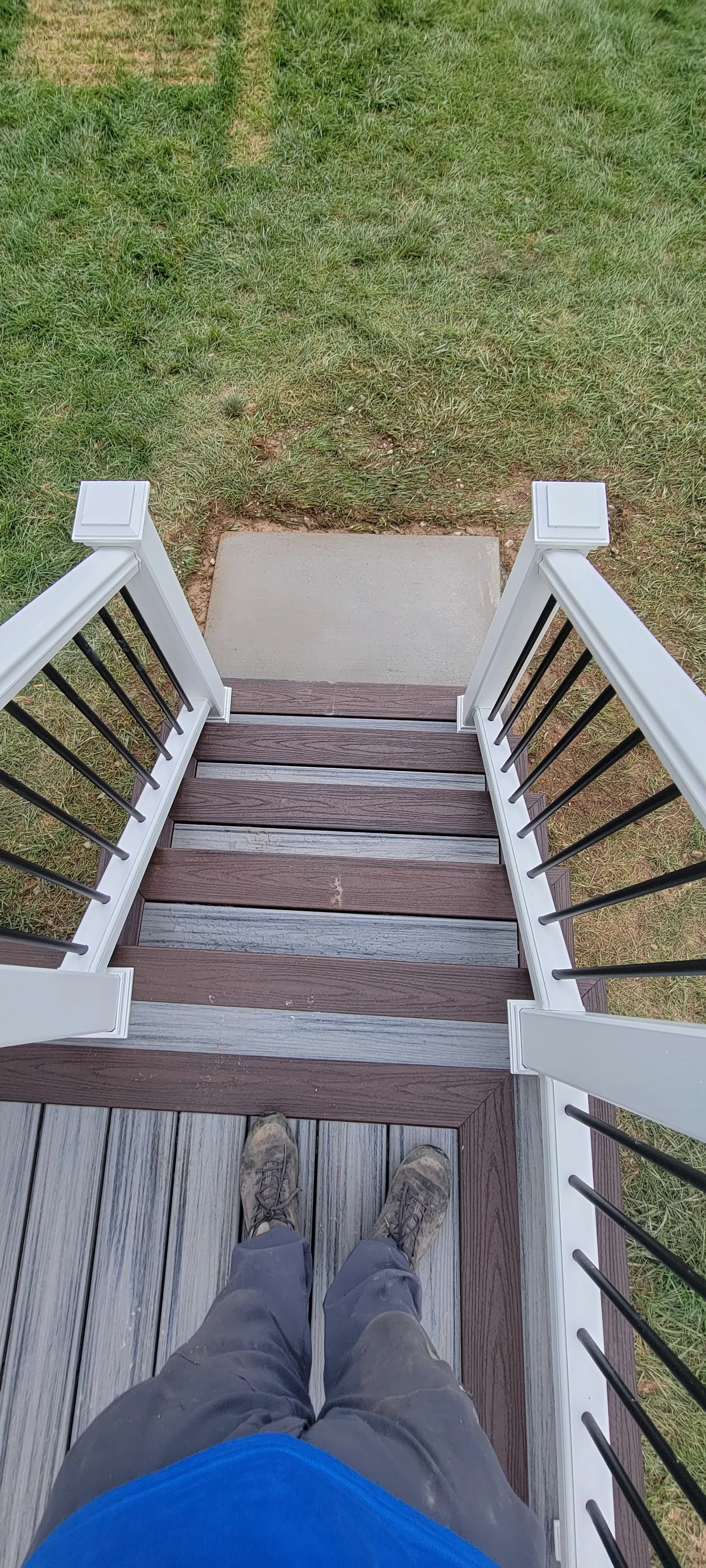
Every composite deck board on the market moves. It expands when it warms and contracts when it cools, and it does this every day of its life, in every season, on every deck. That is not a defect. It is the material behaving exactly the way its manufacturer says it will.
So when a deck shows wide gaps in January, tight buckled seams in July, or board ends drifting out of line by year three, the boards are usually not the problem. The problem is that the movement had nowhere controlled to go. Movement is a design input. A deck that handles it was planned to handle it. A deck that fights it loses.
Movement is the spec, not the surprise
Wood-plastic composites and PVC boards change dimension with temperature more than most homeowners expect and in a different pattern than wood. Wood moves mostly with moisture. Composite moves mostly with heat, and it moves most along its length. A long board on a summer afternoon is measurably longer than the same board on a winter morning.
Manufacturers publish this behavior openly. Their installation guides specify gapping for every combination of board line, board temperature, and season. Those tables exist because there is no single correct gap — the right number depends on the product, the length of the run, and how hot or cold the boards are at the moment they are fastened. That is why we do not publish universal spacing numbers in an article, and why any builder quoting one number for every deck is telling you they have not read the table.
Board temperature is not air temperature
Here is the install-day detail that separates crews: the gap tables run on the temperature of the board, not the weather report. A dark board stacked in direct sun can be far hotter than the air around it. Fasten it tight in that state and it is already at its longest — every cold day afterward pulls the gaps wide open. Install the same board cold and tight, and the first heat wave has nowhere to push except into a buckle or a crooked seam.
Our crews gap to the condition of the material in front of them, per the current manufacturer guide for that specific product. It costs nothing extra. It just requires caring on the one day it matters.
Straight joists are the reference plane
Deck boards are only as straight as what they are screwed to. Every seam, every gap line, and every border joint is a reading of the frame underneath. A joist crowned high telegraphs a hump. A joist that wanders off layout drags board ends with it, and by the tenth board the seams are visibly crooked even though every board left the factory straight.
This is a framing standard, not a decking standard. Crowns get oriented and planed, layout gets held to the line, and blocking goes in where board ends will land. We have written before about why the frame decides how long a deck lives; it also decides how straight the deck looks. The surface can never be better than the plane it sits on.
Long runs need somewhere to break
Length is where movement accumulates. Twice the board length means roughly twice the total movement, all of it collecting at the ends. On a large deck, running boards wall-to-wall in unbroken lines is asking a lot of every joint on the perimeter.
The control is geometry. Breaker boards — a perpendicular board splitting a long field into shorter panels — cut each run's movement down to what its joints can absorb, and they turn scattered butt-joint seams into one deliberate line. A picture-frame border does the same work at the perimeter: it contains the field, covers the cut ends, and gives the eye a finished edge instead of a row of exposed board ends creeping with the seasons. On our builds those elements are drawn into the layout before the first board is cut, because they are structural decisions wearing a design detail's clothes.
Fastening is a system, not a screw count
How a board is held decides how it moves. Three details do most of the work:
- Hidden-fastener discipline. Clip systems hold boards at every joist while still permitting engineered movement. They only work when every clip is seated and driven to the spec torque — a skipped or under-driven clip is a board free to wander.
- Butt joints land on support. Two board ends meeting need solid bearing and fastening under both ends, which means blocking planned at the framing stage. An unsupported joint opens, lips, and rocks.
- The perimeter is fastened differently. Board ends, borders, and stair nosings take fastening details the field does not, because the ends are where movement concentrates. Manufacturers detail this; the guide governs.
None of this is visible on a finished deck. All of it is visible three summers later.
Heat and water underneath change the math
A deck's underside is part of its movement behavior. Boards trapped over a sealed, unvented cavity run hotter and swing harder than boards with air moving beneath them. Standing water under a low deck keeps framing wet, and wet framing moves on its own schedule, carrying the surface with it. Ventilation and drainage under the deck are set at design time — clearance, open or vented skirting, ground that drains — and they quietly reduce the daily stress on every joint above.
Diagnose before you repair
When a deck already shows gaps, buckling, or wandering seams, replacing boards is the last step, not the first. The question is which system failed:
- Surface: a damaged or defective board — rare, and usually obvious.
- Frame: crowned, twisted, or off-layout joists telegraphing through. New boards will follow the same bad plane.
- Fastening: missing or under-driven clips, unsupported joints. Boards are fine; the grip is not.
- Geometry: runs too long with no breaks, no border containment. The layout needs to change, not the material.
Re-decking over the wrong diagnosis buys the same failure in new boards. If the deck is at that crossroads, our guide to repair, resurface, or rebuild walks the full decision.
A composite board that moves is doing its job. A deck that stays straight through ten Hudson Valley summers was built by people who planned for that movement — in the frame, in the fastening, and in the layout. The board never had a choice either way.
Frequently asked
Are gaps between my composite deck boards normal?
Gaps that change with the seasons are normal — composite moves with temperature, and manufacturers require gapping so it can. Gaps that grow year over year, or that vary wildly from board to board, point to an installation problem: boards fastened hot and tight, missed clips, or joints without support.
Why are my deck boards buckling in summer?
Buckling means the boards warmed up, got longer, and had nowhere to go — usually because they were installed cold with too little gap, run too long without a breaker board, or pinned hard at the perimeter. The fix is diagnosing where the movement is blocked, not just replacing the buckled board.
Can crooked seams be fixed without replacing the deck?
Sometimes. If the boards are drifting because clips were skipped or joints lack blocking, the surface can often be corrected board by board. If the joists underneath are crowned or off layout, the frame is the problem, and new boards will drift the same way until it is corrected.