Building a Deck Over a Septic Tank: The Bridge Footing That Makes It Possible
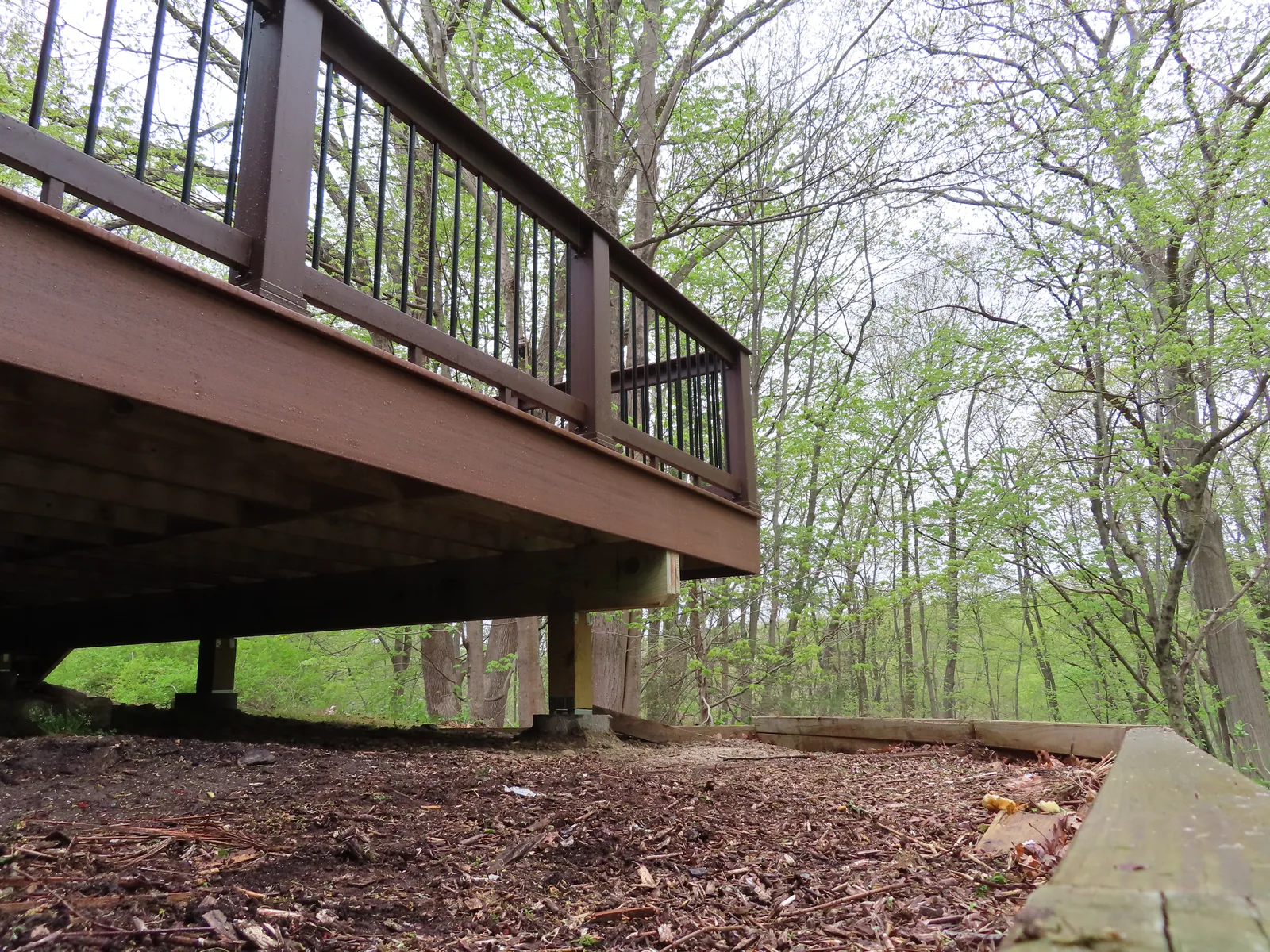
A septic tank in the middle of the ideal deck footprint stops most deck plans cold. The usual answers are to shrink the deck, shift it somewhere worse, or — the dangerous one — build over the tank and hope. Hope is not a load path.
There is an engineered answer: bridge it. On a recent full-property restoration in LaGrange, NY, the tank sat exactly where the multi-level deck needed to land. Here is how the structure spans it without the tank ever carrying a pound.
The rule: the tank carries nothing
A septic tank is a buried box with a working lid, not a foundation. The soil above and around it is disturbed backfill that settles, and the tank walls were never designed to take structural point loads. Set a footing on or near them and you risk a cracked tank, a punctured line, a failed municipal inspection — or a deck that moves every year.
So the design rule is absolute: the ground directly above the septic tank bears zero structural weight from the deck. Everything else follows from that.
Step 1 — move the load outside the failure zone
The primary load-bearing points go completely outside the tank's influence area. We drive engineered helical piles deep into stable soil, well away from the tank walls, until the installation torque verifies the bearing capacity at each pile. That torque reading is a measured number, not an assumption about what the soil is doing next to a buried box.
Two ultra-secure anchor points, both in ground that has nothing to do with the septic system.
Step 2 — clear-span the tank
From those anchor points, a heavy-duty bridge beam assembly spans the entire width of the tank area. The weight of the deck levels above transfers down into the beams, then outward to the piles. The sensitive ground is bypassed entirely — the same way a bridge crosses a river without standing in it.
The beam sizing, spans, and connections are engineered for the real loads: dead load, live load, snow load, and the point loads of the framing above. This is calculation work, not carpentry intuition.
Step 3 — keep the lids reachable
A septic system needs pumping, inspection, and occasional service for as long as the house stands. The bridge design is calculated to hold clearance above the tank's access lids, so the system can be serviced without tearing up custom carpentry. If a design buries the lids to make the framing easier, the design is wrong.
Why the finish work depends on the bridge
Rigidity is the hidden payoff. On that LaGrange restoration, the surface above the bridge is TimberTech by AZEK PVC in Castlegate, laid in a custom herringbone inlay with a black picture-frame border. Herringbone lives or dies on its miters — dozens of joints that either stay tight or open into gaps.
A foundation that cannot settle is what keeps them tight. Because the piles are torque-verified and the beams clear-span the unstable zone, the frame above them does not move when the backfill around the tank does. The intricate work stays flush for decades instead of telegraphing every soil shift.
A beautiful outdoor space is only as good as the foundation under it. Unstable soil, steep grade, buried utilities — the projects that look effortless are the ones where the groundwork was engineered first. Engineering and permits are included in every Pinnacle project, never a line item.
Frequently asked
Can you build a deck over a septic tank?
Not by bearing on it. A deck can span a septic tank when the load is carried by engineered footings placed outside the tank's influence area and a beam assembly clear-spans the tank itself — with zero structural weight on the ground above the tank, and with the local health department and the engineer signing off on the design.
Does building over the tank block pumping and inspection?
It must not. A correct bridge design maintains clearance above the tank's access lids so the system can be pumped, serviced, and inspected without removing any structure. Access is a design requirement, not an afterthought.
Are helical piles safe to install near a septic system?
Yes, when they are located outside the required offsets from the tank and lines and verified by installation torque. The pile locations come from the system's as-built map and physical verification, not from guessing where the tank probably is.
Does the same approach work over a leach field?
No. Leach fields and designated reserve areas need open, unloaded, uncompacted soil to work, and most health codes heavily restrict or prohibit building over them. Spanning a tank is an engineering problem; covering an absorption field is a health-code problem. They are not the same decision.