What Does a Luxury Deck Cost in the Hudson Valley
There is no menu price for a deck. Anyone who gives you a per-square-foot number over the phone before they have seen your property is guessing, and the guess is usually low so they can win the job. We will not do that to you. But you deserve to understand what actually moves the number before you call anyone, so you can tell a real bid from a fantasy.
Every site is different. The same deck design costs differently on a flat suburban lot than it does on a Hudson Valley hillside. Here is what drives it.
The foundation is the part you cannot see and cannot skip
What is under the deck matters more than what is on top of it. A deck on a flat lot with good soil sits on standard footings. A deck on a slope, on fill, on rock, or near wet ground needs more: deeper footings, more of them, or helical piles driven down to solid bearing. Helical piles cost more than poured footings, but on the wrong soil they are the only thing that keeps the deck from settling and pulling away from the house years later.
This is the part homeowners never see and the part the cheap bids cut first. A builder who quotes you a low number is often planning a foundation that the site cannot actually support. You will not know until the deck starts moving. We size the foundation to the soil and the elevation, and we would rather lose a bid than build on footings we do not trust.
Height and access
A deck twelve inches off the ground and a deck a full story up are different animals. The elevated deck needs taller posts, more bracing, real engineering, and code-compliant rails and stairs. It also costs more to build because the crew is working off the ground for longer. Access matters too. If we can back a truck up to the build, material moves fast. If everything has to be carried around the house and up a slope, the labor goes up. None of this shows in the finished photos, but all of it is in the number.
Size, shape, and what you put on it
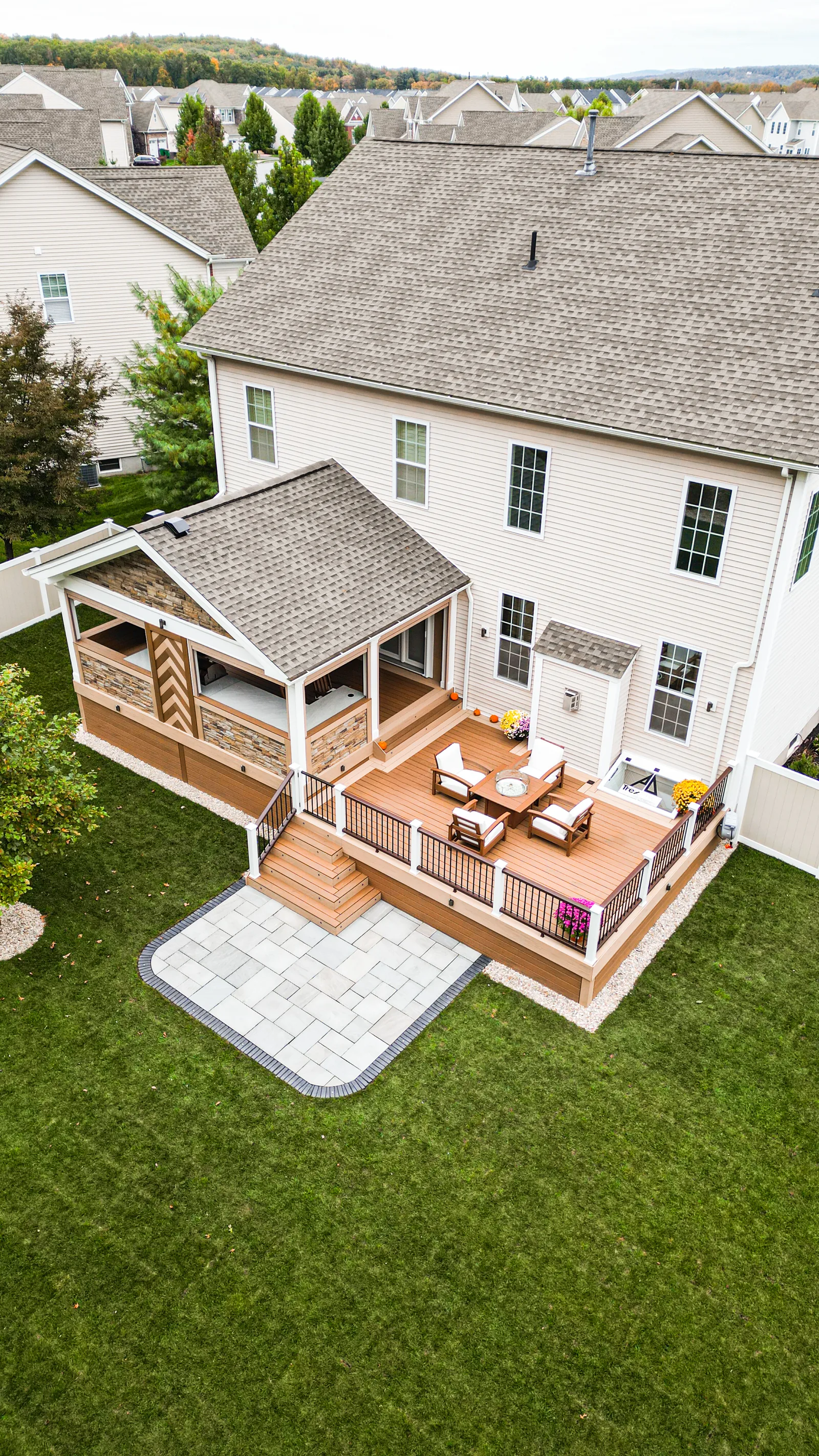
Square footage is the obvious driver, but shape matters more than people think. A simple rectangle is efficient. Multiple levels, curves, angles, wrap-arounds, and built-in seating all add framing complexity and labor. Then there is everything on the deck: an outdoor kitchen, a pergola or roof structure, lighting, an under-deck drainage system with a weather-protected outdoor area below, privacy screening. Each one is its own build inside the build. A bare deck and a full outdoor area are not the same project even at the same square footage.
Material choice
We install the full Trex line, both Signature and the entire Trex Transcend Lineage collection. The right board depends on the project, the site, and your budget, not on what one brochure pushes. There is real range between the lines, and we walk you through what makes sense for your situation rather than defaulting to one. Railing is its own decision too. Cable, glass, aluminum, and composite all land at different points, and the right one depends on your view, your wind exposure, and the look you are after.
Engineering and permits are included, not a separate bill
This is where some builders nickel and dime you, and we do not. Engineering and permits are part of our build. They are not a line item we tack on later or a cost we hand off to you to chase down with the town. A deck this size has to be engineered and permitted to be safe and legal, and we treat that as part of building it right. When you compare our work to a cheaper bid, check whether their number even includes the permit and the engineering, because a lot of them do not, and that gap is real money and real liability landing on you.
Why the cheapest bid always costs more
Here is the uncomfortable truth we tell people at the kitchen table. The lowest bid is almost never the cheapest deck. It is the most expensive one, you just pay for it later. The low bid wins by cutting the parts you cannot see: the foundation, the engineering, the permit, the fastener quality, the flashing where the deck meets the house. Those are the exact parts that fail. A deck that pulls off the house, a ledger that rots because it was not flashed, footings that heave in the first hard winter. Fixing any of that costs more than building it right the first time, and sometimes it means tearing the whole thing out.
We build once. The tagline is not marketing. It is how we price and how we build. We would rather give you a number that holds up than a number that wins the bid and falls apart in year three.
What to expect from a real conversation
When you call us, we come look at the property. We talk through the site, the foundation it needs, the height, the design, the materials, and everything you want on the deck. Then we give you a real number tied to your actual project, not a phone guess. The investment range lives in that conversation, where it belongs, because that is the only place it can be honest.
If you are collecting bids, bring us in. We will tell you straight what your site needs and where the cheap numbers are hiding their cuts.
Call (845) 985-1000 or request a free deck estimate at pinnacledecking.com.
Frequently asked
Why won't you give me a price per square foot over the phone?
Because it would be a guess, and an honest guess is useless to you. The foundation your site needs, the height of the deck, the access, and what you want built on top all move the number, and we have not seen any of that yet. A per-square-foot phone quote is how builders win jobs they later cut corners on.
Are engineering and permits extra?
No. Engineering and permits are part of our build, not a separate line item. A deck this size has to be engineered and permitted to be safe and legal, and we treat that as part of doing the job right. Watch whether a cheaper bid even includes them, because many do not.
Why is the cheapest bid usually a bad deal?
The low bid wins by cutting the parts you cannot see: the foundation, the flashing, the fasteners, the engineering, the permit. Those are the exact parts that fail. You pay for it later in repairs, and sometimes in tearing the whole deck out and starting over.
What is the single biggest cost driver?
Usually the foundation, because it depends entirely on your site. Flat ground with good soil takes standard footings. A slope, fill, rock, or wet ground may need deeper footings or helical piles. It is the part nobody sees and the part that matters most.