Under-Deck Covered Outdoor Retreat — What Is Possible Below Your Deck
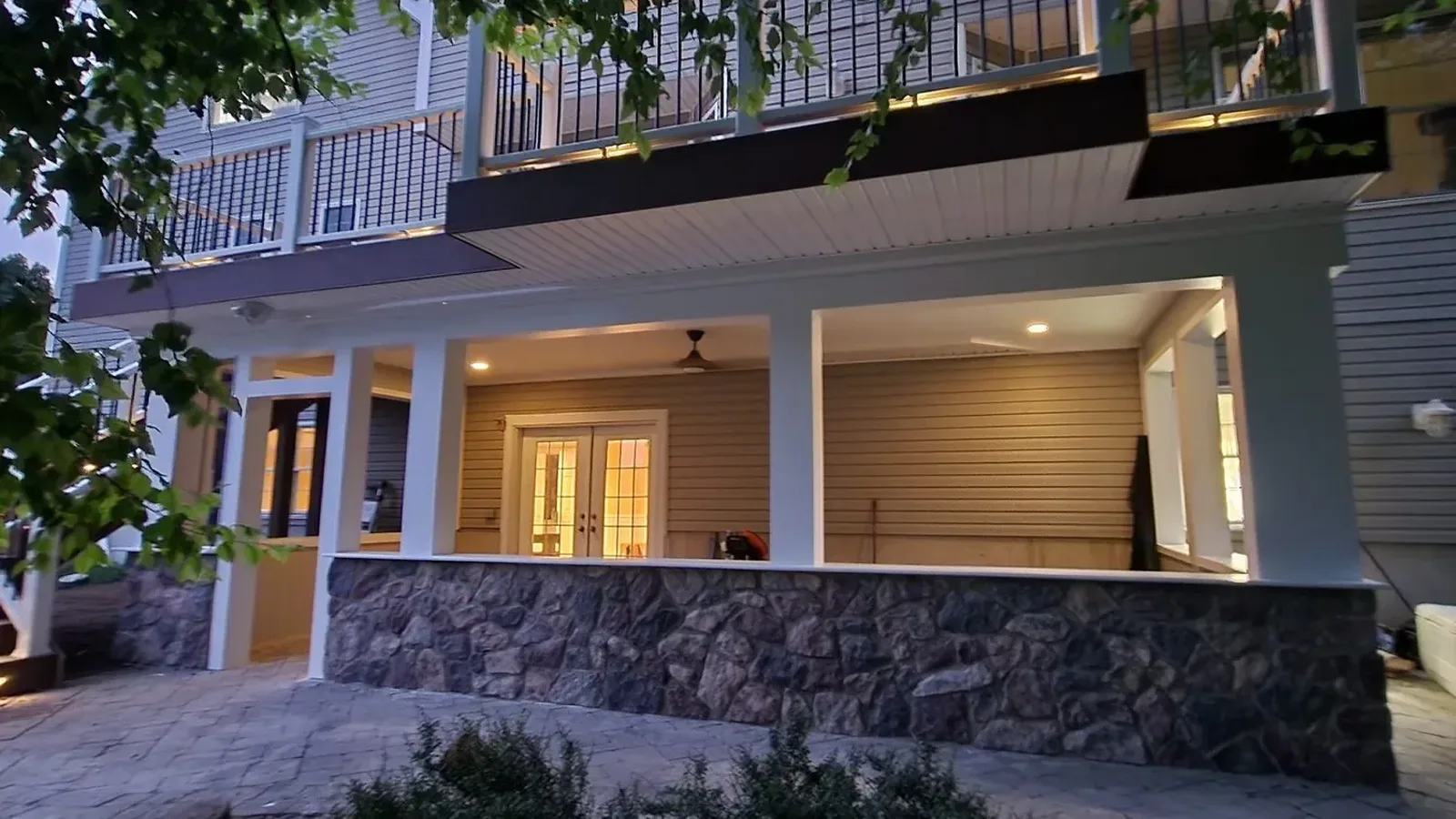
If your deck sits a story off the ground, you already own a second outdoor room. Most people put a hose and a lawn mower down there and live with the drip. Every rain that hits the boards becomes weather on your head. That is not destiny. It is a drainage decision that should have been made before the decking went down.
An elevated deck gives you a second outdoor space for free. The footprint is already built. The roof is already over it. All that stands between you and a dry, covered patio is a drainage system and the decision to do it right. We build these all over the Hudson Valley, and the homeowners who add an under-deck covered outdoor area almost always tell us it became their favorite part of the house.
How the drainage system works
Wood and composite decks both have gaps between the boards. That gap is on purpose. Boards need to drain and breathe. But that gap also means every drop of rain that hits the deck ends up on whatever is below it. So the space under a normal elevated deck is wet, dark, and useless.
Trex RainEscape changes that. It is a system of troughs and downspouts that mounts to the top of your floor joists before the decking goes down. Picture a network of angled channels that catch water as it falls through the gaps and carry it to a gutter at the edge. The water runs off where you want it to, not onto your head. The joists stay dry, which also means they last longer. Once RainEscape is in, the space below becomes a true ceiling instead of a leaky one.
This only works if it goes in during the build, before the boards are fastened. Trying to add drainage after the deck is finished means tearing the deck back up. This is one of the reasons we ask early whether you want to use the space below. It changes how we build the deck above.
What a finished under-deck ceiling looks like
Once the water is handled, we close in the underside. We run a finished ceiling, usually an aluminum panel system or a clean soffit, so you are not staring up at the bottom of your deck boards. The result reads like a weather-protected outdoor area, not a crawl space. Walls can stay open for an airy covered patio, or we can screen them in to keep the bugs out.
You end up with a shaded, dry space that stays cooler than the deck on top of it in July. People put outdoor sofas down there. Dining tables. A hot tub. A TV for watching the game out of the sun. It becomes the spot everyone gravitates to on a hot afternoon.
Lighting and electrical below
A dark ceiling cavity is wasted, so we light it. Recessed lights in the finished ceiling, perimeter lighting, or fixtures over a seating area all turn the under-deck space into something you use after sundown. Because the ceiling is sealed and dry, we can run proper electrical down there: outlets for a TV or a fridge, a ceiling fan, dedicated circuits for whatever you plan to plug in.
All of that gets planned in the same pass as the deck above. Engineering and permits for the structure and the electrical are part of our build, not a surprise line item you find later. We size the framing, the drainage, and the wiring as one system so nothing fights anything else.
What projects benefit most
Not every deck is a candidate. A deck two feet off the ground has no usable outdoor area under it. The projects that pay off are the elevated ones, where the deck sits high enough to walk under comfortably. Walkout basements and homes built into a hillside are the best of all, because the lower level already opens onto grade. In those cases the under-deck covered outdoor area connects straight to the back of the house and becomes part of the daily flow, not a separate trip outside.
Hudson Valley terrain creates a lot of these lots. Homes step down a slope. Decks sit a full story above the yard. That is exactly the situation where the space below is worth claiming.
What it adds to your home
A covered, dry, lit outdoor area is real usable square footage. You roughly double the footprint of the deck without pouring a single new foundation. For resale, an elevated deck with an outdoor area underneath shows far better than a tall deck with a muddy void below it. For living in the house, it gives you a place to be outside when it is raining or when the sun is too much. That is the part homeowners do not expect and never give back.
If you have an elevated deck or you are planning one, decide on the space below before we build, not after. It is the difference between one outdoor area and two.
Call (845) 985-1000 or request a free deck estimate at pinnacledecking.com.
Related reading
Frequently asked
Can I add an under-deck drainage system to my existing deck?
Only by removing the decking boards first, because the drainage troughs mount on top of the joists before the boards go down. If your deck is older and due for resurfacing anyway, that is the right time to add it. On a newer deck, the cost of pulling it apart usually does not make sense.
Does the under-deck space stay completely dry?
Yes, when it is built correctly. The RainEscape system carries water off the joists to a gutter at the edge, so the finished ceiling below stays dry in normal rain. That is what makes it safe to run electrical and put furniture down there.
How high does my deck need to be to make this worthwhile?
You want enough height to stand and walk comfortably underneath, so single-story elevated decks and walkout situations are ideal. A low deck a couple feet off the ground does not give you a usable outdoor area. We will tell you honestly at the consultation whether your height makes it worth doing.
Can you add lighting and outlets under the deck?
Yes. Because the ceiling is sealed and dry, we run recessed lighting, fans, and outlets as part of the build. Plan the electrical with us up front so the circuits are sized for what you actually want to use down there.