Why We Build on Helical Piles in the Hudson Valley
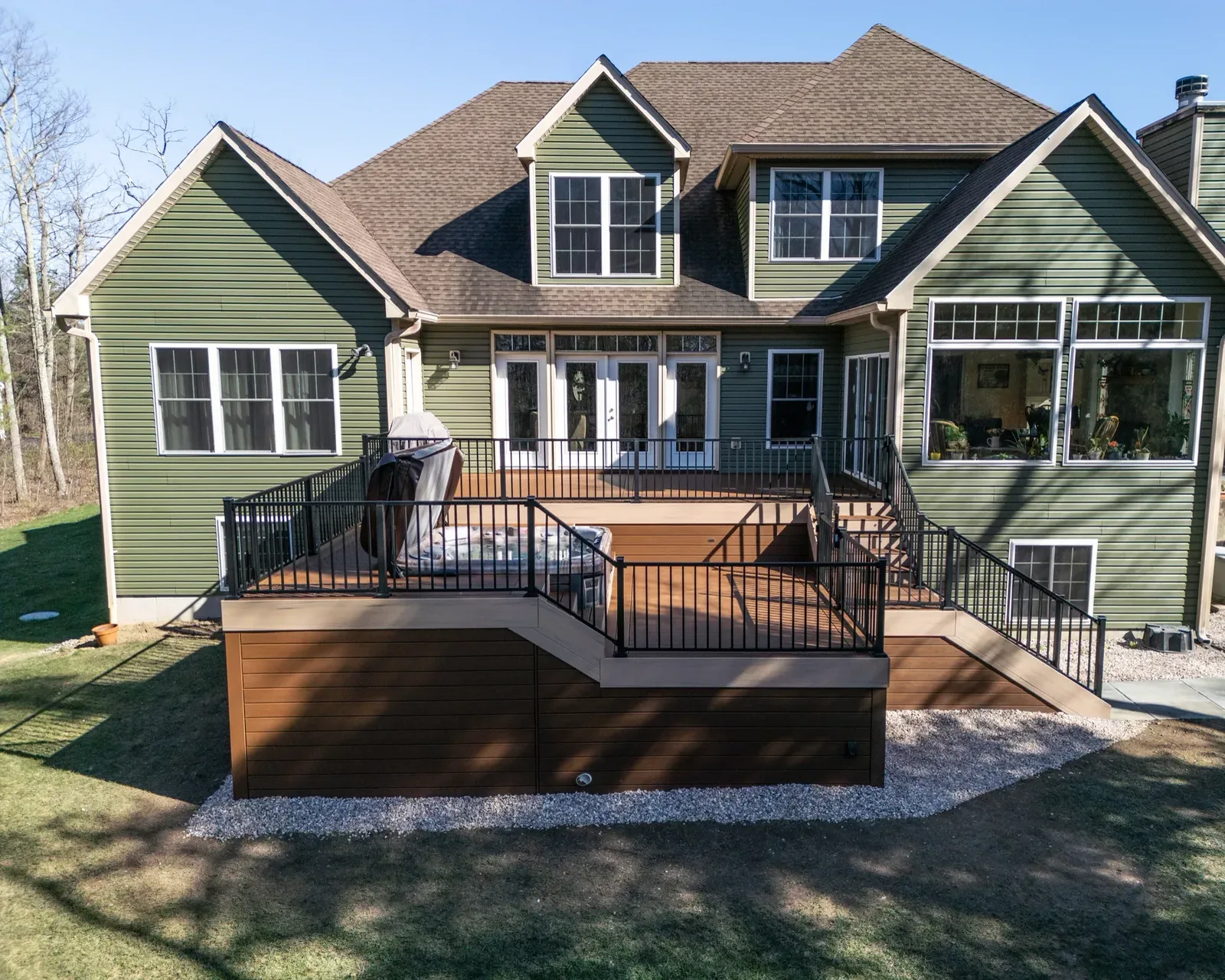
Most deck failures in the Hudson Valley don't start at the railing or the boards. They start underground, in the foundation, where freeze-thaw soil moves a structure that was never engineered to stay still. The fix isn't a bigger concrete frost footing. It's a different foundation entirely.
The problem with poured footings here
Hudson Valley winters drive frost deep, and our soils hold water. When that water freezes it expands, lifting whatever sits in it; when it thaws, the ground settles unevenly. A concrete frost footing poured to the wrong depth — or into the wrong soil — rides that cycle season after season. The result shows up a few years later: doors that bind, gaps opening at the ledger, a deck that no longer sits level.
Pouring a wider or deeper footing helps, but it still depends on undisturbed bearing soil that many of our sloped, rocky sites simply don't offer.
What a helical pile actually is
A helical pile is a galvanized steel shaft with helix plates welded near the tip. Crews drive it into the ground hydraulically, turning it down past the frost line to a depth where the soil can carry real load. The machine measures torque as it goes, and torque correlates to capacity — so we get a verified bearing number for every pile rather than an assumption.
That gives us three things a poured footing can't match here:
- Depth below frost, every time, regardless of how cold the winter runs
- Measured capacity at each pile, documented for the engineer of record
- Minimal site disturbance — no wide excavations, no spoil piles, no waiting on concrete to cure
Why it matters for an elevated deck
The taller and more cantilevered the structure, the less forgiving it is of foundation movement. Our elevated decks, covered structures, and outdoor kitchens concentrate significant load on a handful of points. Helical piles let us place those points exactly where the engineering wants them and trust they'll stay put — on a riverfront slope, in saturated soil, or against bedrock where a conventional footing would be guesswork.
How it fits our process
Engineering and permits are part of how we build, not a line item — and the foundation is where that shows. Pile layout, depths, and capacities are engineered to the specific site and submitted as part of the permit set. By the time boards go down, the part you'll never see has already been verified.
Related reading
- The Deck You Never See: Why the Frame Decides How Long the Deck Lives
- Is the Deck You Inherited Safe? A Homeowner's Inspection Checklist
Frequently asked
Are helical piles better than concrete frost footings?
For most elevated decks in our freeze-thaw climate, yes. They reach below the frost line reliably and give a measured load capacity at each point. On sites where bedrock is close to the surface, we may pin concrete directly to ledge instead — the site review decides.
Will a helical pile foundation cost more?
It depends entirely on the site, the design, and the soil. We don't publish prices because no two Hudson Valley lots load the same. What you get either way is a foundation engineered not to move, with permits and structural drawings included.
Do helical piles work on a sloped or rocky lot?
Yes — that's where they shine. They install with minimal excavation and can be placed on grades and in tight conditions that make conventional footings impractical. Where solid rock stops the pile short, we adapt the detail to bear on the rock.
How do I get started?
Call (845) 985-1000 or request a free deck estimate. We review the site, talk through what you're picturing, and give you a detailed investment range built around your property.