Why Deck Lighting Fails After the Boards Go Down
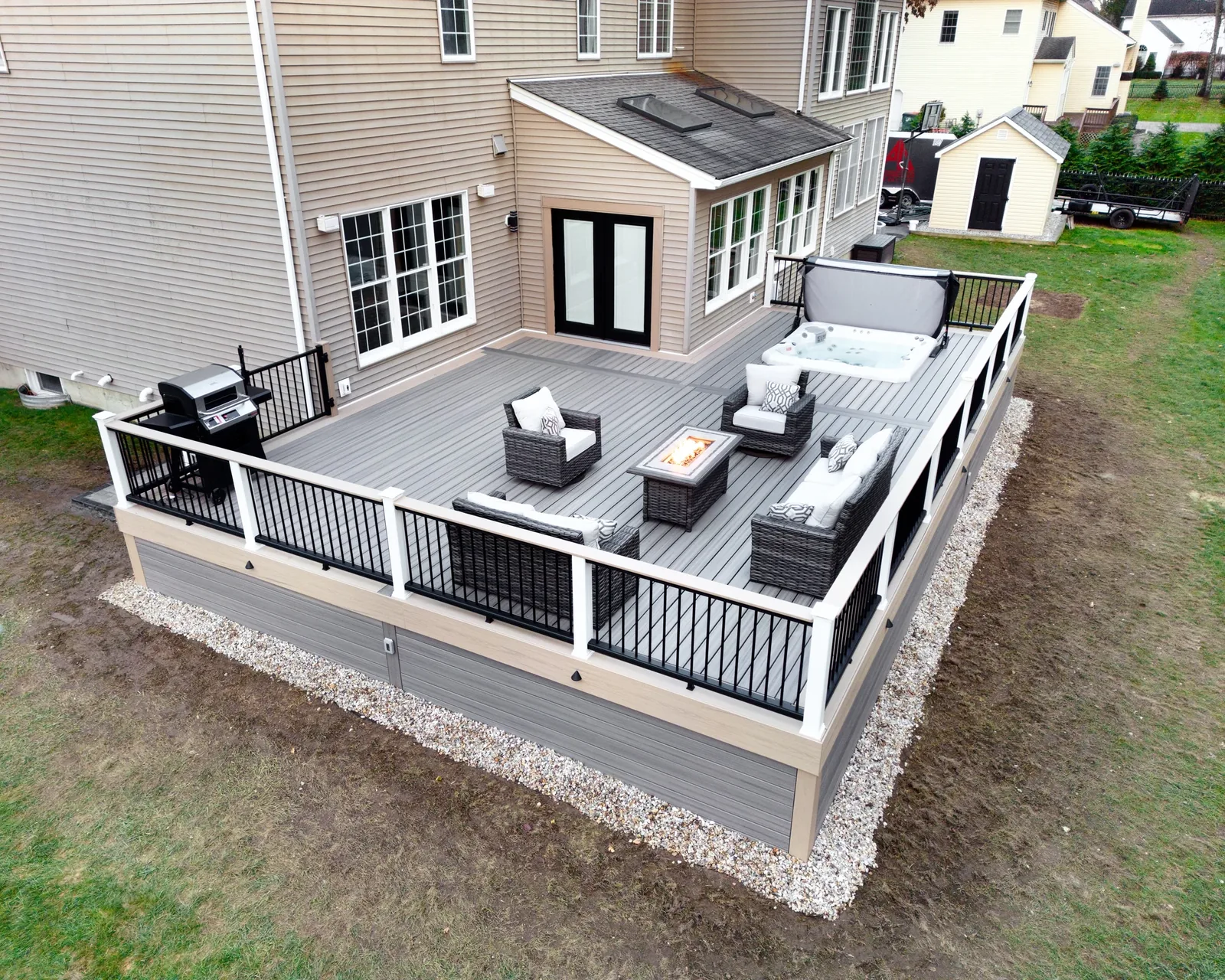
Deck lighting almost never fails at the fixture. The fixture is the last part to arrive and the first part to get blamed, but by the time a light flickers, dims, or dies, the failure is usually years old — it happened on paper, before the decking closed, when nobody planned where the wire would live, how much load the system would carry, or how a human being would ever service a connection buried under a fastened surface.
That is the uncomfortable truth of low-voltage deck lighting: it is infrastructure first and atmosphere second. Installed as infrastructure, it runs quietly for years. Installed as an accessory — fixtures bought late, wires fished wherever they fit — it becomes the only part of a premium deck that ages badly. Here is where the failures actually start, and what a real lighting plan settles before a single board goes down.
The failures are baked in early
The service calls we see trace back to the same short list:
- An undersized plan. The system was scoped for the fixtures someone counted on day one, with no headroom for load, run length, or the zone that got added during the build.
- Inaccessible connections. Splices and hubs sitting directly under fastened decking, reachable only by demolition. The first failed connection turns into a board-removal job.
- Voltage drop nobody calculated. Fixtures at the far end of long runs starving, glowing dimmer and yellower than the ones near the transformer.
- No zoning. Every fixture on one switch — so the choice is airport apron or darkness.
- No service map. Nobody wrote down where the wires run, where the connections sit, or which run feeds which zone. Every future repair starts with archaeology.
- Wiring trapped behind finish. Fascia, skirting, and stair treads installed over wire paths with no slack and no route out.
None of those are fixture problems. All of them are sequence problems — which is why lighting design belongs at the same table as framing and decking layout, a point we made in our walkthrough of what actually happens during a deck project: lighting rough-in has its own slot in the build order, after framing and before the surfaces close.
Zones first, fixtures second
A lighting plan does not start with which lights. It starts with which jobs:
- Stairs — the safety zone. Every flight lit, every night, no exceptions.
- Perimeter — the edge of the deck defined after dark, so the surface reads as a place and the drop-off reads as a boundary.
- Task — the grill, the outdoor kitchen counter, the table where things actually get done.
- Circulation — the path from door to stair to yard, lit as a route.
- Ambient — the low layer that makes the space feel inhabited after the task lights go off.
Each zone has its own fixtures, its own control, and its own schedule. Zoning is what lets a deck be bright for a dinner party, dim for a late drink, and stair-only at midnight — and it is a wiring decision, not a dimmer purchase. Retrofitting zones into a single-circuit deck means opening the deck. On our builds the full-color systems we install are zoned and scene-controlled from the start; our Haven lighting guide covers what that system does once it is in.
Capacity and distance are design math, not install-day guesses
Every low-voltage system runs off a transformer, and the transformer has a capacity. The plan has to add up the connected load, leave honest headroom for the zone that always gets added, and account for the fact that wire itself eats power over distance.
That last one is voltage drop, and in homeowner terms it works like water pressure at the end of a long hose: the farther the fixture is from the transformer, and the more fixtures drinking from the same line, the less arrives at the end. The fixtures do not fail — they just run dim, uneven, and off-color, permanently. The cures are decided at layout time: heavier wire where runs are long, more home runs instead of one daisy chain, and transformer placement chosen for the wiring plan rather than for whatever outlet was closest. There are published methods and manufacturer tables for all of this; the point is not the arithmetic, it is that someone does the arithmetic before the boards close.
Every connection needs a future
Wire is not what fails. Connections are — and outdoors, a connection's life is decided by where it lives. The rules we build to are simple:
- Every splice, hub, and junction sits in a dry, drainable, reachable location: an accessible bay, a serviceable void, behind a removable skirt panel — never under fastened field boards.
- Service loops — deliberate slack — at every fixture and connection point, so a fixture can be pulled, inspected, and replaced without re-pulling the run.
- Runs labeled at both ends, and an as-built map — which zone, which run, which route — handed over with the project documents. Ten years from now, that map is the difference between a twenty-minute fix and an exploratory demolition.
This is the least glamorous part of lighting and the part that determines its whole service life. A connection you can reach is a maintenance item. A connection you cannot is a countdown.
Light for navigation, not runway glare
The design goal after dark is legibility: you can see where the surface ends, where the steps are, and where the path goes, without a single fixture shouting. In practice that means low, shielded sources that light treads and surfaces rather than eyes, and it means rhythm — stairs lit consistently, every riser or every landing on the same logic, because a skipped step in a lit flight reads as a step that is not there. Perimeter fixtures spaced to define the edge, not to strobe it. Task light where the work is, and nowhere else.
And because color-capable systems live or die by tuning: commissioning happens after dark. Scenes get set at night, on the finished deck, with the household standing on it — not estimated from a couch at noon. That evening walkthrough is a scheduled step in our builds, the lighting equivalent of a final coat inspection.
One more thing that belongs on paper: low-voltage does not mean no rules. These systems still fall under electrical code, the transformer still needs a compliant supply, and where the plan touches line voltage — new circuits, outlets, service panels — licensed electrical work gets coordinated as part of the project, the same way engineering and permits are simply part of every build we run. "It's only low voltage" is how corners get cut; the system deserves the same paperwork discipline as the structure it lights.
Deck lighting that works in year ten was planned in week one — zoned on the drawings, sized with headroom, wired with slack, documented on a map, and tuned in the dark. The fixtures were never the hard part.
Frequently asked
Why are the lights at the far end of my deck dimmer than the rest?
That is voltage drop: long runs and shared lines deliver less power to the last fixtures, like water pressure fading at the end of a long hose. It is designed out at layout time with heavier wire, shorter runs, and smarter transformer placement — which is why it is hard to cure after the deck is finished without opening things up.
Can lighting be added to an existing deck without removing boards?
Some of it. Post caps, rail lights, and surface-mounted fixtures can often be retrofitted cleanly. In-deck and riser lights, buried wire paths, and new zones usually cannot — their wiring lives under the surface, which is why lighting is planned before the boards go down on our builds.
Do low-voltage deck lights require an electrician?
The low-voltage side is forgiving, but it is not lawless — electrical code still applies, and the transformer needs a proper, compliant power source. Wherever a project adds line-voltage circuits or outlets, licensed electrical work is coordinated as part of the job. Low voltage is a wiring class, not an exemption.