Helical Pile Foundations — Hudson Valley, NY
Steel piles driven past the Hudson Valley frost line and torque-verified to engineered depth — the reason a Pinnacle deck doesn't heave, twist, or settle through twenty winters.
Why concrete frost footings fail in Hudson Valley ground.
The soil here freezes and thaws all winter long. Water under a concrete frost footing freezes and lifts it — frost heave — and pulls the framing with it. The sagging corner that shows up five winters in is almost never the deck; it is the ground moving under a footing that should never have been poured there.
Helical piles bypass the problem entirely. Each steel pile turns down through the soil until it reaches a verified torque value — on most lots that means bearing into dense till or shale well below the frost line, beneath the zone where soil moves. The torque reading gives us the real capacity of every pile as it installs, so each one is sized to its actual load.
We install them as Mascore Certified Installers, and on historic homes they carry the deck's full load on its own foundation instead of hanging modern weight off a wall that was never built for it.
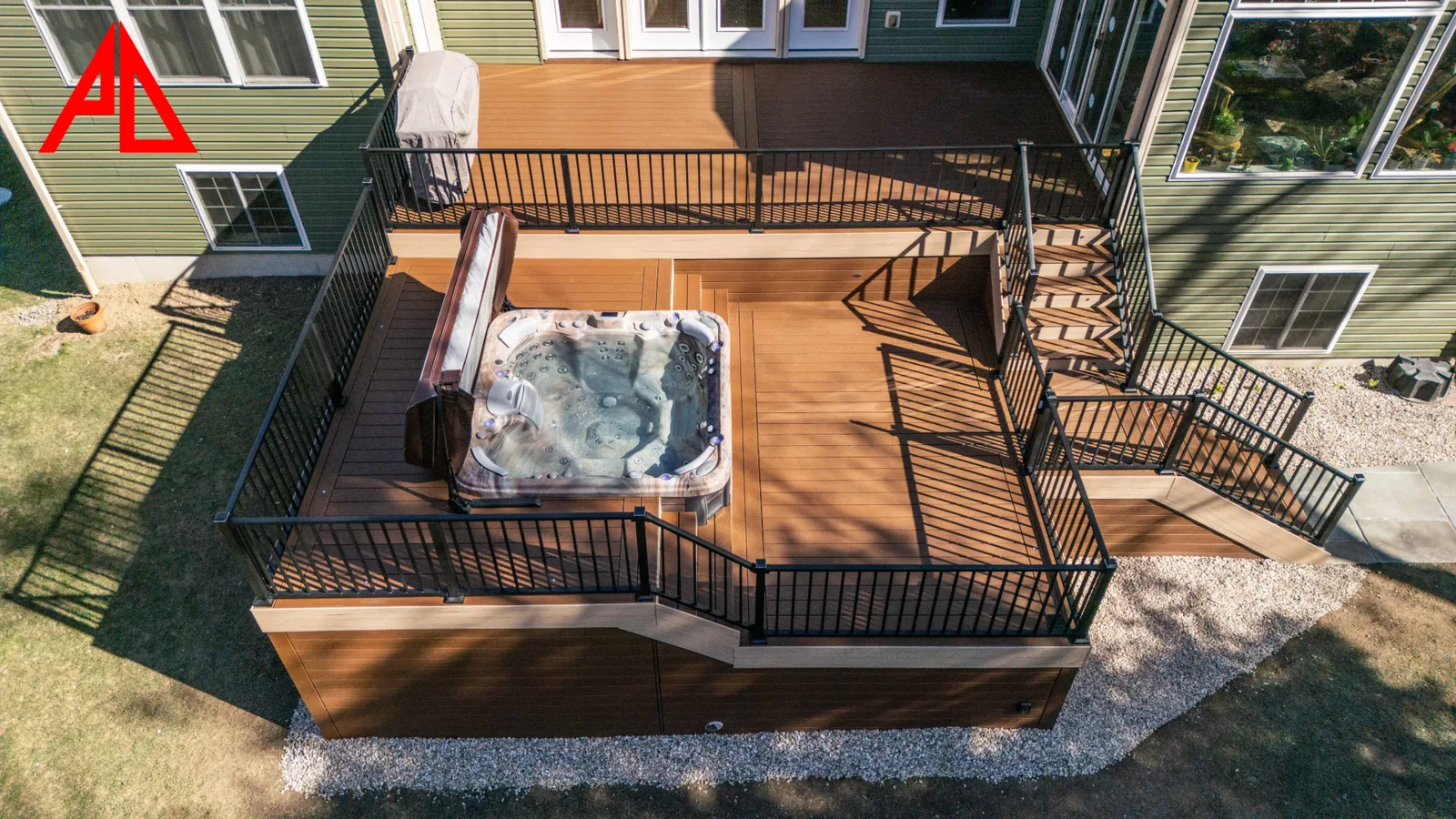
Different counties, different ground, same verification.
Dutchess clay holds water like a sponge and heaves hardest when saturated. Westchester sits on shallow rock and steep grades. Putnam builds into hillsides and ledge rock above the river. Orange runs from rolling farmland to deep black dirt that is a poor bearing surface for anything poured into it.
The advantage of helical piles is that each one answers its own ground: where rock sits near the surface we bear on the rock; where soil runs soft or deep a few feet over, that pile drives down to firm bearing below frost. One deck, every pile at full verified capacity — something a row of identical concrete piers cannot do on uneven ground.
Every foundation plan ships inside sealed structural drawings. Engineering and building permits are carried inside our scope, not billed as a separate line item.
Homeowners ask.
What is a helical pile, exactly?
A steel shaft with helical plates that we turn into the ground like a screw until it reaches a verified torque value corresponding to its load capacity. It bears in firm soil below the frost line, so the structure above it does not move with the seasons.
How do you know each pile will hold?
By the torque reading at installation — a measured, verifiable number for every single pile, not an assumption about the soil. Each pile is sized to its actual load before the framing ever starts.
Do helical piles work on rocky or wet lots?
That is where they earn their keep. On rock we bear on the rock; in wet clay or soft soil the pile drives through to firm bearing below frost. Mixed ground on a single lot is exactly the condition piles solve.
Trex Composite Decking - Under-Deck Living - Helical Piles Guide - What Is a Helical Pile? - Case Study: Hudson Horizon Haven - Dutchess County - Putnam County - Westchester County - Orange County
Ready to plan your project?
Every build starts with a design consultation. Engineering and building permits are carried inside our scope, not billed as a separate line item.